Garage Door Off Track Repair in Park Hill Denver
Starting at $199.00
If your garage door is crooked, grinding, or a roller has come out of the track, stop using the opener and call Harmony Garage Door Repair Denver. We provide safe, thorough garage door off track repair in Park Hill Denver, starting at $199.00 for standard track realignment (final price depends on door configuration, root cause, and whether rollers, cables, or track hardware need replacement).
Park Hill is one of Denver’s most architecturally varied historic neighborhoods — and that variety extends to the garages. South Park Hill’s bungalows and Tudor-revival homes, built largely in the 1920s and 1930s, have detached alley-access garages that often still carry original or early-replacement hardware. North Park Hill, developed more heavily through the 1940s and 1950s, has a mix of original single-car setups and garages that were expanded or updated when attached carports were converted to enclosed structures. The neighborhoods around 23rd Avenue and below share the alley-garage culture of most central Denver, while properties along Colorado Boulevard and the east end of Park Hill have more variety in garage orientation and access. Whatever the vintage or configuration of your Park Hill garage, an off-track door needs a real diagnosis — not a roller shove back into the rail and a wave goodbye.
Call for a free estimate: (720) 999-5723
Common Off-Track Signs We See in Park Hill
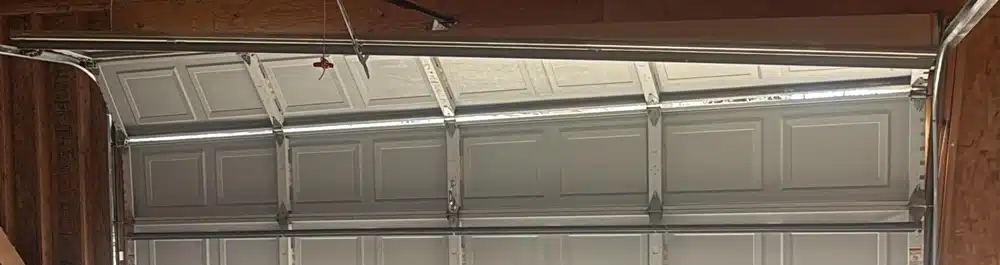
- The door is crooked or racked in the frame — one side sitting noticeably lower, or the door askew in the alley opening
- Grinding or metal-on-metal scraping when the door moves — a roller stem or hinge bracket dragging against the track wall instead of rolling through it
- A roller visibly outside the track channel — often visible at the upper corners of the door from inside the garage
- The opener strains, hums without completing travel, or auto-reverses — the motor is fighting resistance from a stuck or skipped roller
- The door stops mid-cycle and won’t go further in either direction
- Track brackets that look bent or pulled slightly away from the wall — particularly on garages where the original framing is aging
Stop running the opener the moment any of these appear. Continued activation against a stuck door on an older Park Hill system can pull bracket anchors further out of aging framing, stress cable terminations that are already past prime, or strip opener gears — escalating the repair cost and complexity significantly.
What Causes a Garage Door to Go Off Track in Park Hill?
Aging Hardware in South Park Hill’s Historic Homes
The bungalow and Tudor streets of South Park Hill — Elm, Fairfax, Glencoe, Leyden, and Monaco Parkway south of 23rd Avenue — are home to some of Denver’s most intact historic residential fabric. They’re also home to garage door systems that haven’t been touched in a very long time. Original steel rollers, angle-iron track, and hinge plates on these garages can still function adequately in year 30 or 40 — but by year 50 or 60, the bearings inside the steel rollers are typically worn to the point of failure. When the bearing goes, the roller stops spinning and starts to drag along the track floor, gradually working its way to the track edge. The warning signs — a rougher, louder door — often precede the actual derailment by months. If your Park Hill door has been getting progressively louder, the rollers are almost certainly the issue.
Alley Garage Configurations — Park Hill’s Alley System
Most of Park Hill’s residential garages — particularly in South Park Hill and in the blocks below 26th Avenue — are detached structures accessed from the alley easements that run behind every block. Alley garages in Park Hill range from original single-car wood-frame structures to later block additions that were expanded when households acquired second vehicles. The common thread is that the track is configured to work with alley clearances and low-to-moderate headroom — and low-headroom track configurations have tighter plumb tolerances than standard setups. A bracket that shifts a small amount in a low-headroom track can disrupt the roller path in a way that wouldn’t cause an immediate problem in a higher-clearance installation.
Foundation and Framing Movement in Older Structures
Denver’s older neighborhoods experience ongoing foundation micro-movement from the expansive clay soils that characterize much of the urban core — and Park Hill, with its density of early 20th-century construction, is no exception. Garage structures that were built separately from the main house foundation can shift slightly relative to the alley grade over decades. That movement — even when it’s imperceptible to the eye — can pull track brackets slightly out of plumb and stress the lag anchors. If the bracket anchors have backed out due to framing movement, the track geometry may be compromised even if no one has touched the garage hardware in years.
North Park Hill — Postwar Conversions and Mixed-Era Hardware
The homes in North Park Hill, built more heavily through the 1940s and 1950s, sometimes have garages that started as carports or open structures and were enclosed later. These conversions often involved installing overhead door systems in openings that weren’t originally designed for them, which can mean non-standard track mounting geometry, custom bracket configurations, or hardware from different generations mixed into the same system. When any component of that mixed system reaches its limit, diagnosing the actual cause requires looking at the whole picture, not just the spot where the roller came out.
Impact from Alley Traffic
Park Hill alleys, like most Denver alley systems, carry regular traffic from residents, deliveries, and contractor vehicles. The lower track section and bottom bracket on an alley-facing garage are directly exposed to that traffic — and low-speed contact from a vehicle mirror, a delivery cart, or a bike can shift the lower bracket enough to displace the roller path without leaving any visible mark on the door panel. If your Park Hill door went off track suddenly rather than gradually, checking the lower bracket area for shift or impact damage is part of the inspection.
Our Park Hill Off-Track Repair Process
- Safety assessment: We evaluate door position, cable condition, spring integrity, and whether the door is safe to manipulate — with particular attention to older systems where hardware tolerances are tighter.
- Full track inspection: Plumb, spacing, bracket tightness, and track channel condition across the full track run. On Park Hill’s older garages, we also check track gauge compatibility with current-spec rollers.
- Roller evaluation and replacement: Wheel wear, bearing condition, stem integrity. On vintage systems, we assess whether current-spec rollers will function in the existing track profile or whether the track needs modernization.
- Track realignment and bracket re-anchoring: We correct plumb, re-square the track, and re-anchor brackets in solid framing — identifying sound wood where original anchor points have loosened or failed.
- Cable and drum check: Both cables inspected for seating and condition. On older garages, original wire rope cable may be frayed or kinked — we flag deteriorated cable for replacement.
- Balance test: Door held at mid-travel to confirm spring balance. Springs on older Park Hill garages are often undersized for the current door weight after years of panel additions or door replacements.
- Opener alignment and cycle testing: Opener alignment verified. Multiple open/close cycles run before we close out the repair.
Off-Track Repair Pricing in Park Hill
Our garage door off track repair in Park Hill Denver starts at $199.00. Final pricing depends on:
- Door size and weight — including whether it’s original single-car width or a later expansion
- Roller condition and compatibility — whether replacement rollers work in the existing track or whether the track system needs updating
- Track condition — realignment only, or section replacement where bends or corrosion prevent correction
- Whether cable, spring, or opener alignment work is involved
- Bracket re-anchoring complexity on older framing structures
We’ll walk you through the full diagnosis and all available options before any work begins.
When to Stop Using the Door
- The door is crooked or racked in the opening
- A roller is visibly outside the track channel
- The opener is straining, humming, or auto-reversing without completing travel
- You hear grinding, metal scraping, or a pop during operation
- A cable looks slack, frayed, or is hanging
- The door dropped suddenly or feels unusually heavy
On older Park Hill systems, running the opener against a stuck door is particularly risky — vintage hardware has less safety margin than modern components, and bracket anchors in aging framing can pull through under repeated opener force. Call us before activating the opener again.
Serving Park Hill and Nearby Denver Neighborhoods
Harmony Garage Door Repair Denver serves Park Hill and surrounding northeast Denver neighborhoods, including:
- South Park Hill and North Park Hill
- Hale and Mayfair
- City Park West and Stapleton/Central Park border areas
- Cole and Clayton neighborhoods
- Northeast Park Hill
Not sure if your address is covered? Call and we’ll confirm service availability and the fastest scheduling window.
Related Garage Door Repair Services
If the off-track inspection turns up vintage hardware beyond safe service life, deteriorated cable, spring imbalance, or track incompatibility with modern rollers, we can walk you through repair and upgrade options. See our full Garage Door Repair Services or check our Service Areas for complete coverage.
Local FAQs: Garage Door Off Track Repair in Park Hill Denver
My Park Hill garage looks original to the 1930s house. Is it worth repairing or should I just replace everything?
It’s worth evaluating before assuming replacement. If the track is structurally sound, the framing can hold brackets reliably, and the track gauge accepts current-spec rollers, a targeted repair — new rollers, re-anchored brackets, realigned track — can return the door to reliable operation for many more years. Full replacement makes sense when the track itself is too far from current specs, the framing has failed beyond repair, or the door panel is also at end of life. We’ll give you an honest assessment of both paths and what each would cost.
I’ve noticed my Park Hill garage getting louder over the past year. Is that a sign it will go off track?
Increasing noise — particularly grinding, scraping, or a rhythmic clunking — is almost always a sign of roller wear on older systems. The progression is typically: bearing wear → roller wobble → increased noise → roller climbs track edge → derailment. Catching it in the “increased noise” phase is significantly cheaper and less disruptive than waiting for the derailment. If you’re hearing new sounds from a Park Hill garage system, a roller inspection and replacement before failure is the right move.
What’s the difference between South Park Hill and North Park Hill garage systems?
South Park Hill homes, built primarily in the 1920s-30s, tend to have the oldest garage structures — often original single-car alley garages with vintage hardware. North Park Hill homes, built more heavily in the 1940s-50s, have a mix of original systems and postwar conversions with more varied hardware configurations. The practical difference for repairs is that South Park Hill garages are more likely to have true vintage track that requires compatibility assessment, while North Park Hill garages more often have hardware from the 1980s-90s that’s simply reached end of life.
Can I use my car if the garage door is off track?
If your car is inside and the door is stuck, don’t attempt to force the door without guidance. Call us first — we can walk you through a safe manual release procedure over the phone based on what you’re describing. If the door is in a position where it can be safely secured temporarily, we’ll advise that as well. Getting the car out safely is the priority, and we’d rather talk you through it than have you create additional damage trying to force a stuck door.
My alley garage in Park Hill has very little headroom clearance. Will that affect the repair?
Low-headroom configurations require specific attention to bracket geometry and opener mounting, but they don’t prevent a proper repair. We work in low-clearance Park Hill alley garages regularly. If the existing hardware is low-headroom compatible, we realign within those parameters. If a track or hardware replacement is warranted, we source low-headroom compatible components for the configuration. Let us know when you call that the clearance is tight — it helps us come prepared with the right hardware.
Schedule Off-Track Repair in Park Hill
A crooked or stuck garage door in Park Hill — whether it’s a 1920s original or a more recently updated system — is a safety issue that warrants a proper repair. Harmony Garage Door Repair Denver will stabilize the door, identify the root cause, realign the track, and confirm safe operation before we leave.
Track realignment starts at $199.00.
Need help with a different issue? Visit our Garage Door Repair Services page to see everything we do, or check our Service Areas to confirm coverage across the Denver metro.